Data Alone Is Not Enough
Many businesses collect data, but the process often ends there.
A lead fills out a form, so the campaign gets credit because the numbers look good.
But what happens next?
Did that lead book? Did they qualify? Did they become a customer? Those are the questions that matter.
Most systems never feed that information back.
That means ad platforms keep learning from surface-level actions, not the outcomes that actually drive revenue.
So when the learning stops early, the results often stay limited.
What Happens After the Click
Follow one click through the system and the whole idea becomes clear.
Someone clicks your ad. That click is captured at the network edge — before the page renders, before an ad blocker can interfere — and stamped with an APAS® Click ID that carries its campaign, keyword, and platform click IDs. The visitor gets an anonymous APAS® ID that persists across visits. Fake clicks are scored and filtered out right here, so bots and competitor clicks never pollute what follows.
Days later, the visitor comes back and books a consultation. Weeks later, they qualify in your CRM. Eventually, they sign — and become revenue. Every one of those moments — the form, the booking, the call, the CRM stage change — joins the same journey, connected by those two identifiers.
Most systems stop at the first event and call it a conversion. APAS® Cloud keeps recording — because the moments that matter most happen long after the click.
Teaching the Algorithm What an Ideal Customer Looks Like
Not every lead has the same value.
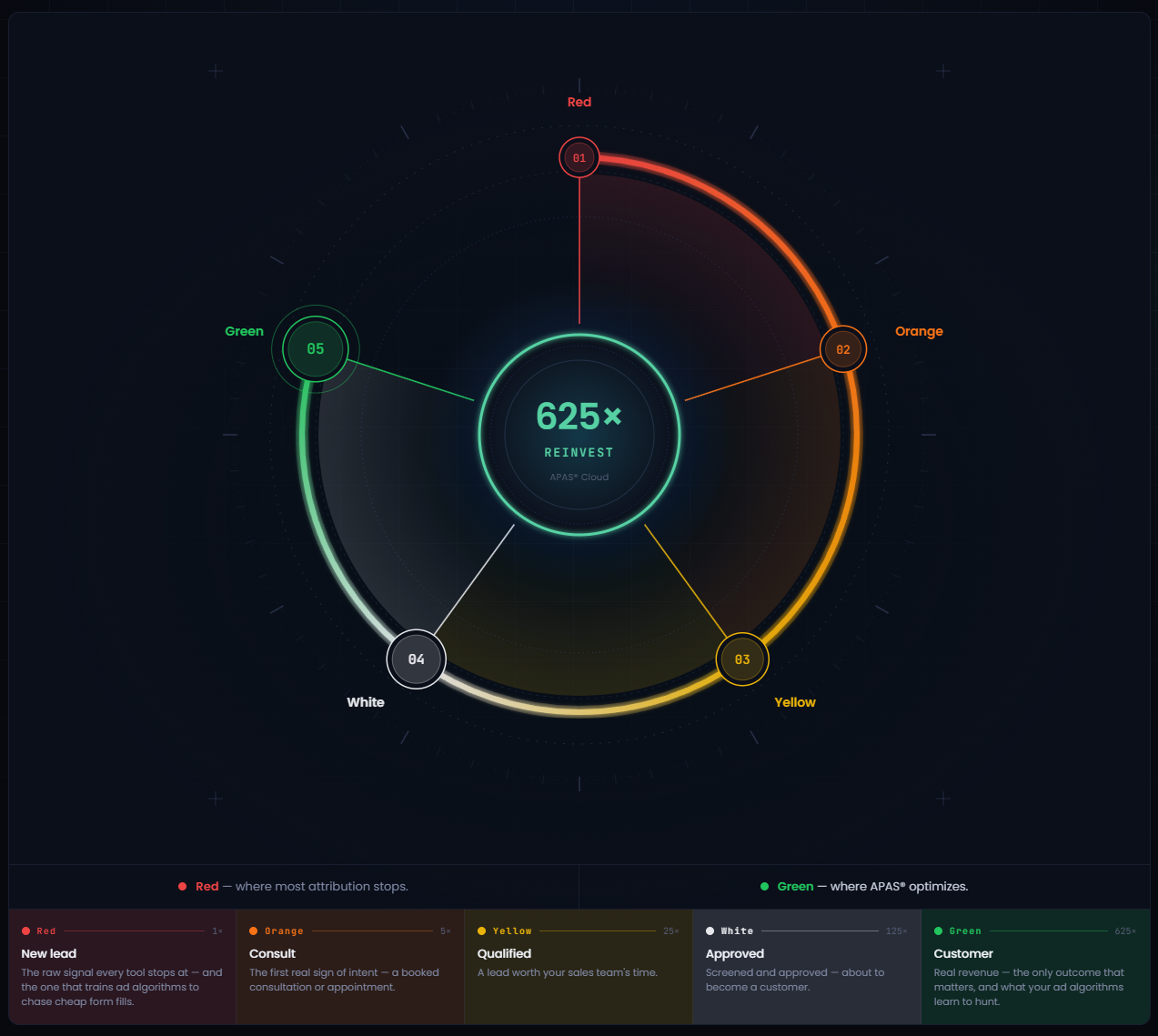
That is why APAS® Cloud uses a simple color-based system to track the customer journey.
Red means a new lead. It counts as 1x.
Orange shows real intent, like a booked consult. 5x.
Yellow means the lead is qualified. 25x.
White means approved. 125x.
Green means customer and revenue. 625x.
Each stage gives the algorithm a stronger signal — every step up the ladder is worth five times the one below, so a single Green teaches the algorithm 625 times more than a Red does.
And the ladder is yours to shape. Those multipliers are the defaults: you can change each stage’s value in-app to match what that stage is really worth to your business, and rename the labels to your own funnel vocabulary. The colors stay consistent underneath, so nothing downstream ever breaks.
And the deeper the lead moves into the funnel, the more valuable that signal becomes. This matters because most tracking setups stop at Red. APAS® Cloud keeps feeding the journey all the way to Green. That changes what the algorithm learns. And the click ID is what ties every stage back to the originating ad — see why preserving click IDs matters.
From Your CRM to the Ad Platforms, Automatically
Here is how those signals actually travel.
Your CRM data — every contact, opportunity, and stage change — streams into your own BigQuery warehouse through APAS® Cloud. Your Google Cloud project, your tables, your data.
Every hour, transformation pipelines read those tables through Dataform and spot what changed: a lead qualified, an opportunity was approved, a deal closed. Each stage change becomes a color conversion, matched back to the click that started the journey.
Then APAS® Cloud runs the data activation pipelines automatically. Every conversion is consent-checked, paired with its click ID, weighted by its stage value, and delivered to every ad platform you run. No manual uploads, no spreadsheets, no engineering tickets — the loop runs on its own, every hour of every day.
That is true account optimization: bidding algorithms continuously retrained on the outcomes your business actually cares about.
The Strategy: Migrate Your Signals Up the Funnel
The pipeline runs on its own. The strategy is in what you feed the algorithms, and when — the single highest-leverage decision you will make, and the one most teams get wrong.
Bidding algorithms need volume to learn. On Google and Microsoft, that means roughly 20–25 conversions per month at a given stage before they can optimize toward it reliably. The goal is to end up optimizing for your best outcome — Green, paying customers — without starving the algorithm before the higher stages have filled in.
Turn all five stages on from day one
Red fills in immediately. Orange, Yellow, White, and Green trickle in as leads progress — days, weeks, sometimes months. A stage that is still empty costs nothing to have on, and the history is already accumulating for the day it matters.
Climb the bidding ladder as your data builds
From a standing start, do not jump straight to value bidding. Run Maximize Clicks while conversion data is thin. Move to Maximize Conversions once you are consistently seeing 25+ conversions a month. Move to value bidding — Maximize Conversion Value or tROAS — once you have that volume in at least two different stages, enough spread for the value signal to mean something.
Let the weights steer, and cull sparingly
Because each stage is worth five times the one below, the algorithm already leans hard toward quality — a Green outweighs 625 Reds. Keep the lower stages on even after the higher ones fill in: they are supporting signal, not competition, teaching the algorithm what low and mid intent look like so it gets sharper at finding the top. Once you have a real read on your conversion rate at each stage, tune the default weights to your funnel’s true economics. And only switch a lower stage off when the upper stages have far more than enough volume on their own.
One caveat: Meta plays by different rules. It needs roughly 50 conversions per week to exit its learning phase, and an ad set’s optimization event is locked once published — so you do not prune in place, you launch a new ad set at the next stage up once the weekly volume is there. And because Meta will not show you the volume of a stage you are not optimizing for, you watch each stage’s true numbers in your APAS® Cloud reports. Every platform rewards the same move — train on the highest-quality stage you can keep fed — but each has its own rules for volume and for how it locks the optimizing event.
Why Better Signals Lead to Better Customers
Ad platforms are built to follow patterns.
The signals they receive shape the decisions they make. So if the only signal is a form fill, the platform will keep looking for that.
But a form fill does not always mean a customer. Often it is not even interest — it is junk, spam, or a bot that slipped through. And when those form fills get reported as conversions, the platform dutifully learns to find more of them. You end up paying for an algorithm that gets better and better at finding junk.
This is why validated signals matter so much: junk can never be validated. A bot cannot book a consultation. Spam cannot qualify in your CRM. A fake lead can never become revenue. The higher a signal sits on the ladder, the harder it is to fake — and by Green, it is impossible.
APAS® Cloud feeds the platforms exactly those validated signals:
Who books.
Who qualifies.
Who converts.
Over time, the algorithm starts aiming for those patterns — the ones junk structurally cannot produce. So not just more leads, but the right leads — because more leads don’t mean more revenue.
The Growth Flywheel in Action
This is where the growth flywheel begins.
Clearer signals create stronger learning. Stronger learning improves targeting. More accurate targeting brings in higher-intent leads. Higher-intent leads convert more often.
That reduces wasted spend and lowers acquisition costs.
So revenue grows.
And that revenue feeds back into the system, giving the next cycle even more momentum.
Each rotation strengthens the next. That is how APAS® Cloud compounds performance over time.
From First Click to Closed Revenue
A customer journey rarely happens in one step. Someone clicks an ad. They return later, book a consultation, qualify, and eventually become a customer.
APAS® Cloud keeps that whole journey connected.
From the first click to the final revenue event, the full path stays visible and useful.
That means teams are not guessing which campaigns are driving growth. They can see it clearly.
And more importantly, their ad platforms can learn from it.
Next Steps
APAS® Cloud was built to turn data into action.
Not all signals carry the same value. And not all leads become customers.
The difference is knowing which outcomes matter most and teaching your systems to act on them.
The APAS® Intelligence Pipeline is designed to do that.
From first click to closed revenue, it keeps the cycle moving and helps teams grow with more clarity, stronger signals, and smarter decisions.
See how APAS® Cloud puts the intelligence pipeline to work for your growth.